Artificial Intelligence
Physical AI: The Next Frontier as Robots, Drones and Warehouses Get Smarter
Physical AI: The Next Frontier as Robots, Drones and Warehouses Get Smarter The first decade of the modern AI boom was, in a sense, a purely digital story. Models learned to write, code, and answer questions, but they lived entirely inside screens and servers. That is changing. Through 2026, one of the fastest-growing corners of the AI industry has been what practitioners call "physical AI" — systems that combine machine perception with real-time decision-making to operate in the physical world, from warehouse floors to delivery drones to manufacturing lines. It's a shift that promises to bring the productivity gains already seen in knowledge work into industries that never fit neatly behind a keyboard.
What Physical AI Actually Means
Physical AI is not simply "robots with AI installed." It refers to a specific architecture: sensors and cameras that let a machine perceive its surroundings, models that interpret that perception in real time, and decision-making systems that translate that understanding into physical action — moving an arm, adjusting a flight path, or rerouting around an obstacle. The key difference from older generations of industrial robotics is adaptability. A traditional warehouse robot followed a fixed, pre-programmed path and stopped or failed when anything unexpected appeared. A physical-AI-equipped system can perceive a dropped box, a person walking into its path, or a shelf in an unexpected location, and adjust its behavior on the fly, much the way a human worker would.
This adaptability is what has made physical AI attractive well beyond the narrow set of tasks industrial robots have traditionally handled. Instead of being confined to a single repetitive motion on a fixed line, these systems can be redeployed across changing environments and tasks with far less custom engineering than earlier automation required.
Warehouses as the Proving Ground
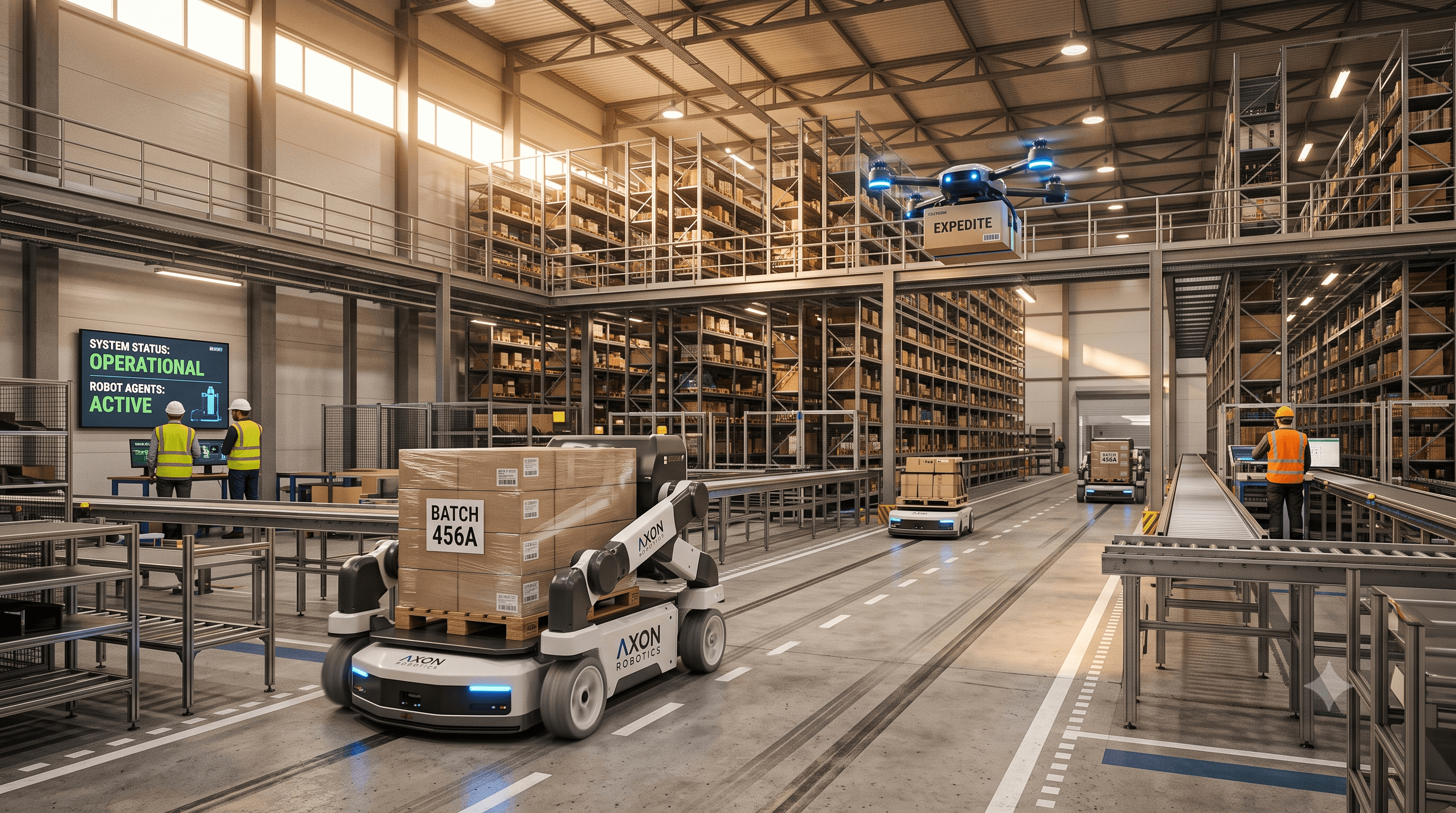
Warehousing and logistics have become the most active testing ground for physical AI, and for good reason: the tasks are physically demanding, chronically understaffed in many regions, and structured enough to make automation tractable without requiring the system to handle truly open-ended situations. Picking, sorting, palletizing, and inventory tracking are all activities where a machine that can perceive its environment and adjust in real time offers a clear improvement over both older fixed automation and manual labor, which is expensive and difficult to scale during demand spikes.
Retailers and logistics companies have been particularly aggressive in piloting these systems ahead of peak shopping seasons, when order volumes surge and hiring temporary labor becomes both costly and unreliable. Early deployments suggest the biggest gains come not from replacing human workers outright, but from handling the most physically strenuous or repetitive portions of a job — heavy lifting, long-distance walking within a facility, or highly repetitive sorting — while people focus on tasks requiring judgment, exception-handling, or customer interaction.
Drones Take On Inspection and Delivery
Parallel to the warehouse story, drones equipped with physical AI are being deployed for tasks that once required a human to physically travel to a site or manually operate a device throughout an entire task. Infrastructure inspection — checking power lines, pipelines, cell towers, and agricultural fields — has become a leading use case, since it combines a genuine safety benefit (keeping humans away from hazardous heights or remote terrain) with a strong economic case (inspections that once took a crew a full day can be completed by an autonomous drone in a fraction of the time).
Agricultural applications have also expanded meaningfully, with drones capable of autonomously surveying crop health, identifying irrigation problems, and even applying treatments to specific areas rather than blanketing an entire field. This kind of precision reduces both cost and environmental impact compared with traditional uniform treatment methods.
Delivery remains the most talked-about but slowest-moving application, constrained less by the underlying technology than by regulatory frameworks, airspace management, and public acceptance. Most commercial drone delivery activity to date remains geographically limited and heavily regulated, though incremental expansions continue as aviation authorities build out rules for low-altitude autonomous flight.
The Investment Behind the Shift
Capital has followed the technical momentum. Established robotics manufacturers, automotive companies looking to diversify beyond passenger vehicles, and a wave of newer specialized startups have all attracted significant investment specifically targeting physical AI applications. Some of this activity has overlapped with — and occasionally been confused for — the long-running push toward autonomous passenger vehicles, but the more immediate commercial traction is concentrated in contained, controlled environments: warehouse interiors, factory floors, farms, and industrial sites, rather than public roads full of unpredictable human drivers.
Ride-hailing and logistics companies have also begun making strategic investments in physical AI ventures, seeking a foothold in industrial automation and delivery infrastructure that could complement their existing platforms. These moves suggest that physical AI is increasingly being viewed not as a niche robotics story, but as a natural extension of the broader AI investment wave that has already reshaped enterprise software and cloud infrastructure spending.
The Hard Problems That Remain
Despite the momentum, physical AI faces engineering and safety challenges that don't have equivalents in purely digital AI. A chatbot that makes a mistake produces a wrong answer; a physical system that makes a mistake can damage property, injure a worker, or cause a genuine safety incident. This raises the bar for reliability considerably, and it's part of why most current deployments are confined to structured environments — a warehouse interior, a farm field, a fixed industrial site — where the range of possible situations a system needs to handle is more limited than the truly open-ended chaos of, say, a public street.
Sensor cost and durability remain real constraints as well. Cameras, depth sensors, and the onboard computing needed to process everything in real time all add expense and points of potential failure, particularly in harsh industrial environments involving dust, vibration, temperature extremes, or moisture. Companies deploying these systems at scale have had to invest heavily in maintenance infrastructure and redundancy, not just the AI models themselves.
There's also a workforce dimension that companies are still learning to navigate carefully. Automating physically demanding tasks can improve safety and reduce injury rates, but it also raises legitimate concerns among workers about job security. The companies that have handled this transition most smoothly have generally been transparent about which roles are being automated and which are being redefined, and have invested in retraining programs that move displaced workers into oversight, maintenance, or exception-handling roles rather than treating automation purely as a headcount reduction exercise.
Where This Is Heading
The trajectory suggests physical AI is following a path similar to the one enterprise software AI has already traveled: starting with narrow, well-defined, high-volume tasks in controlled environments, then gradually expanding in scope and autonomy as reliability improves and trust builds. Warehouses and inspection drones represent the current frontier — the equivalent of customer support chatbots in the earlier generative AI wave. Broader deployment into more open, less controlled environments, including public roads and unstructured outdoor settings, will likely take longer and require both technical maturation and regulatory frameworks that don't yet fully exist.
For businesses in logistics, manufacturing, agriculture, and infrastructure maintenance, the practical takeaway is that physical AI has moved well past the experimental stage for specific, well-bounded tasks. Companies willing to start with narrow, high-value pilots — a single inspection route, one warehouse zone, a defined agricultural use case — are best positioned to build the operational experience and trust needed to expand deployment as the technology, and the rules governing it, continue to mature.