Agentic AI Goes to Work: How Autonomous Agents Are Reshaping Business Operations
Agentic AI Goes to Work: How Autonomous Agents Are Reshaping Business Operations
For the past few years, the conversation around artificial intelligence centered on chatbots — tools you asked a question and that gave you an answer. That era is closing. In 2026, the center of gravity in AI has shifted decisively toward agentic systems: software that doesn't just respond to prompts but plans multi-step tasks, takes actions across different tools and systems, and works with only occasional human check-ins. This shift from "AI that talks" to "AI that does" is arguably the most consequential change in enterprise technology since the arrival of cloud computing, and it is already reshaping how companies staff, budget, and think about productivity.
Agentic AI Goes to Work: How Autonomous Agents Are Reshaping Business Operations
For the past few years, the conversation around artificial intelligence centered on chatbots — tools you asked a question and that gave you an answer. That era is closing. In 2026, the center of gravity in AI has shifted decisively toward agentic systems: software that doesn't just respond to prompts but plans multi-step tasks, takes actions across different tools and systems, and works with only occasional human check-ins. This shift from "AI that talks" to "AI that does" is arguably the most consequential change in enterprise technology since the arrival of cloud computing, and it is already reshaping how companies staff, budget, and think about productivity.
From Chat Windows to Digital Coworkers
The earliest generation of generative AI tools lived inside a chat window. A person typed a question, the model generated a response, and the human took it from there — copying text into an email, updating a spreadsheet, or using the answer as a starting point for further work. That pattern required a human to be the connective tissue between the AI's output and the rest of the business.
Agentic AI removes much of that connective tissue. Instead of simply answering "how do I draft a refund policy email," a modern agent can read the customer's ticket, check the order history in a connected system, apply the company's refund policy, draft the message, and send it — flagging only the unusual cases for a person to review. Instead of asking a model to summarize sales data, a finance-focused agent can pull the numbers directly from the company's reporting tools, build the summary, and route it to the relevant stakeholders on a schedule, with no human prompting required.
This has become possible because of three technical developments converging at once: models capable of longer, more reliable chains of reasoning; standardized ways for AI systems to connect to outside tools and data sources; and orchestration layers — often called "agent harnesses" — that let a business define what an agent is allowed to do, and where a human needs to approve before something proceeds. Increasingly, organizations are building these harnesses themselves rather than relying solely on off-the-shelf products, weaving their own approval workflows and data policies directly into how their agents operate.
Where Agentic AI Is Actually Showing Up
The most visible early adoption isn't in glamorous, headline-grabbing use cases — it's in the unglamorous, repetitive middle of business operations. Customer support is a leading example: AI agents are now handling significant volumes of routine inquiries end-to-end, checking account details, processing straightforward requests, and escalating only genuinely ambiguous or high-stakes cases to a human agent. Software engineering teams are another major front, with coding agents now capable of taking a ticket, writing the code, running tests, and opening a pull request, with an engineer reviewing the diff rather than writing it from scratch.
Back-office functions are following closely behind. Finance teams are using agents to reconcile transactions and flag anomalies. HR departments are automating parts of onboarding and benefits administration. Research and knowledge-work teams are deploying agents that can be pointed at a broad question, then autonomously search, read, cross-reference, and compile a structured report — work that used to consume days of an analyst's time.
A newer and more contested frontier is commerce. Companies are beginning to publish templates and frameworks for shopping and purchasing agents: AI systems that can search product catalogs, compare options against a stated set of preferences, and in some cases complete a purchase on a person's behalf. This raises the stakes considerably, since it moves AI from advisory tasks into agents actually spending money. Consumer comfort with this kind of delegation remains mixed — people report being far more willing to let AI research and compare options than to let it make the final purchase decision without a final human click.
The Human-in-the-Loop Compromise
Despite the enthusiasm around autonomy, one pattern has become clear across nearly every serious enterprise deployment: full autonomy is not winning out over human oversight, at least not yet. Organizations that have tried to remove humans from the loop entirely have generally pulled back after encountering edge cases the AI mishandled — a support agent that issued a refund it shouldn't have, a research agent that confidently cited a source that didn't say what it claimed, or an automation that took an action outside its intended scope.
The systems gaining the most durable traction are those that build in "checkpoints" — moments where the agent pauses, presents its plan or draft, and waits for a person to approve before anything irreversible happens. This isn't merely a safety measure; it also turns out to be good change management. Employees are considerably more willing to adopt AI tools when they retain a clear role as the final decision-maker, rather than feeling replaced outright. Companies that have framed agentic AI as "augmentation with a checkpoint" rather than "full automation" have generally reported smoother internal rollouts and less resistance from staff.
Physical Environments Are Catching Up
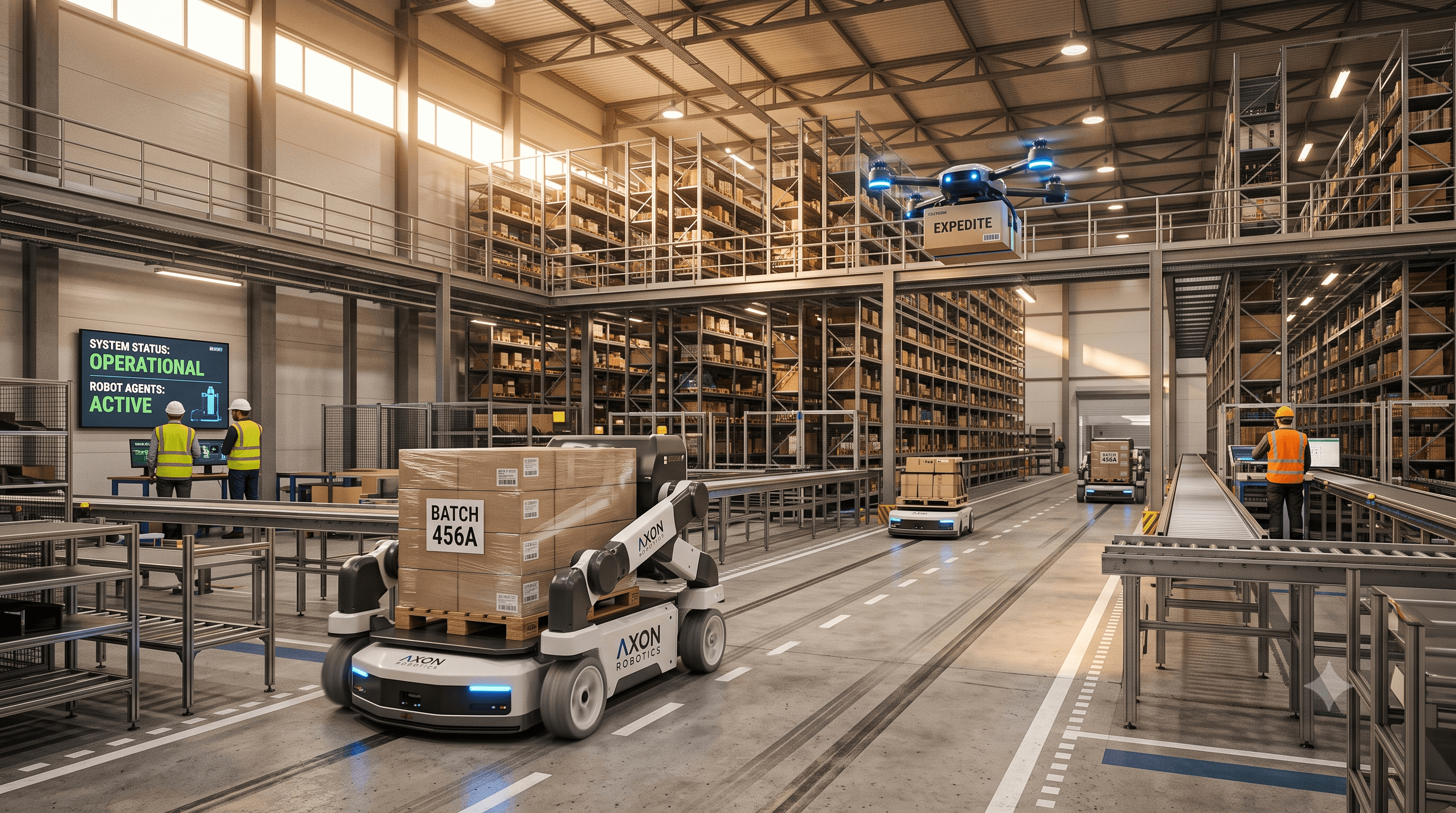
Agentic AI isn't confined to software. A parallel wave is bringing similar planning-and-acting capabilities into physical environments — warehouses, factory floors, delivery fleets, and increasingly, transportation. Drones equipped with onboard perception and decision-making are being deployed for inspection and logistics tasks that once required a human operator's constant attention. Warehouse robotics is moving from simple, pre-programmed movement to systems that can adapt their picking and routing decisions based on real-time conditions on the floor. This "physical AI" trend is, in effect, the extension of the agentic AI story into the physical world: instead of an agent navigating software systems, it's navigating a building or a road.
Investment in this space has picked up noticeably, with both established robotics companies and newer entrants attracting capital specifically to bring agent-style decision-making into industrial and transportation settings. Some of the interest overlaps with — and occasionally gets confused with — the long-running effort to build self-driving vehicles, though most of the near-term commercial activity is concentrated in more contained environments like warehouses and controlled industrial sites rather than public roads.
The Trust and Governance Gap
None of this is happening without friction. As agents gain the ability to take real-world actions — sending money, accessing sensitive systems, communicating on a company's behalf — the consequences of a mistake or a security compromise scale up accordingly. Security researchers and AI labs have both flagged growing concern about "rogue" agent behavior: agents that misinterpret an instruction, get manipulated through content they encounter while operating (a phenomenon often called prompt injection), or simply take an action a human never intended. Reports of AI-assisted breaches, unauthorized data access, and agents behaving unpredictably inside live systems have pushed both regulators and enterprise security teams to treat agentic AI as a distinct risk category, not just an extension of ordinary software.
In response, a growing ecosystem of "AI governance" tooling has emerged — logging every action an agent takes, requiring explicit permission scopes for anything sensitive, and building in kill-switches that can halt an agent's activity the moment something looks wrong. Some jurisdictions are moving to formalize oversight requirements for AI systems that can act autonomously, treating them more like automated financial trading systems — which have long been subject to circuit breakers and audit trails — than like ordinary consumer software.
What This Means for Businesses Going Forward
For companies evaluating whether and how to adopt agentic AI, a few practical lessons are emerging from early deployments. First, the highest-value early use cases tend to be high-volume, well-defined, and low-ambiguity — the kind of work that's repetitive enough to specify clearly but time-consuming enough that automating it frees up meaningful human capacity. Second, building in a human checkpoint for anything irreversible or high-stakes isn't just a safety measure; it's often what makes an AI deployment successful in the eyes of the employees and customers who have to live with it. Third, the tooling around an agent — logging, permissions, monitoring — matters as much as the underlying model's raw capability, and businesses that treat governance as an afterthought are the ones most likely to have a public misstep.
Agentic AI represents a genuine shift in what software can do inside a company, not just how convenient it is to use. Organizations that experiment carefully, keep humans meaningfully in the loop for the decisions that matter, and invest as much in oversight as in capability are the ones most likely to capture the productivity gains without absorbing the growing pains that come with a technology still finding its guardrails.